

An increasing number of foreigners living in Japan are starting educational businesses by leveraging their own experience and skills. Language schools, cooking classes, yoga lessons, and IT skills courses are being offered across a wide range of fields. In recent years, the spread of social media and video-sharing platforms has made it easier for individuals to attract students on their own.
At the same time, managing reservations and scheduling manually can create various operational issues. As the number of students grows, instructors often receive inquiries in both Japanese and their native language while also having to manage multiple communication channels such as email, social media, and phone calls. As a result, it becomes difficult to secure enough time for lesson preparation and student support, which should be the main focus of the business.
To maintain stable class operations, it is essential to establish a reservation system that allows students to register smoothly. This article explains the importance of reservation management and efficient operational methods for foreigners who are currently running or planning to start classes in Japan.
Why reservation management is important for foreigners running classes in Japan
Creating a structured reservation management process not only reduces operational workload but also improves convenience for students and helps prevent missed enrollment opportunities. Even before launching a business, it is important to establish a system that can handle registrations and scheduling consistently.
Improving student convenience and preventing lost opportunities
Many students in Japan, especially those balancing work or school, tend to search for classes during evenings or weekends and prefer to register immediately after checking available time slots. However, when reservations are accepted only by phone or email, students must wait for a response, which can lead them to abandon the registration process midway.
This is especially true for fields where students want to book immediately, such as language schools or IT skills courses. Providing an environment where reservations can be made 24 hours a day can help expand opportunities to attract students. Moving reservation management online is an effective way to prevent avoid missing potential students .
Reducing scheduling coordination costs
For yoga, dance, and personal fitness training (PT), instructors frequently receive questions such as “Is there availability on this day?” or “Can I change the lesson time?” In addition, instructors who travel between multiple studios or locations may spend a significant amount of time coordinating schedules individually, which can affect core tasks such as lesson preparation.
Managing available slots can become especially complicated for one-on-one lessons or small-group classes. However, by centrally managing reservation information, availability checks and schedule adjustments can be automated and handled more efficiently.
Preventing reservation errors and double bookings
Manual management using notebooks or spreadsheets carries the risk of reservation issues and double bookings caused by input errors or missed confirmations. In classes such as cooking or handicrafts, where venue capacity and the amount of materials or ingredients are limited, exceeding the participant limit can significantly disrupt operations.
In Japan’s business environment, scheduling mistakes can directly damage student trust and may lead to long-term business losses. Implementing an automated management system helps reduce human error and supports stable operations.
Common challenges in class reservation management

At the beginning of a business, manual management may still be manageable. However, as the number of students increases, the administrative burden can quickly grow. Understanding potential operational challenges in advance is essential for maintaining smooth business operations.
Reservations spread across multiple communication channels (SNS・Messaging apps)
Foreign instructors often use multiple tools for marketing and communication. LINE and Instagram may be used to reach Japanese customers, while Facebook and WhatsApp are commonly used for multinational audiences. As the number of communication channels increases, managing reservation information becomes more complicated, and the risk of missed replies also rises.
This is especially important for individually operated businesses, where maintaining a centralized environment for managing all reservation information is critical.
Increased time spent handling cancellations and schedule changes
For classes such as cooking or art lessons that require ingredients or specialized equipment to be prepared in advance, last-minute cancellations or schedule changes can result in financial losses. Handling cancellations individually also increases the instructor’s workload, and if vacant slots cannot be refilled in time, revenue may decline.
Using systems that allow students to modify their own reservations or automatically set deadlines for changes can help address these issues effectively.
Complicated tuition collection and payment management
When operations rely only on cash payments or bank transfers, confirming payments and managing payment statuses can become time-consuming. This becomes even more complicated when multiple lessons or curriculums are offered, as instructors must track who has enrolled in which course and whether payment has been completed.
In addition, for businesses that collect payment on the day of the lesson, no-shows without prior notice can create financial risks, such as covering fixed costs like studio rental fees.
Essential features for effective reservation management

To achieve efficient operations, it is important not only to accept reservations but also to implement systems equipped with features that reduce administrative workload and prevent operational issues. Many modern reservation systems now include these functions as standard features, helping improve the efficiency of class management.
24/7 online reservations with automatic reception
By introducing online reservations, the system can automatically accept bookings even outside business hours or while instructors are teaching lessons. Students can register whenever it is convenient for them, making it easier to avoid missed reservation opportunities.
This type of system is especially useful for individuals operating classes as a side business or running their business independently.
Automatic reservation confirmation and reminder notifications
In addition to sending confirmation emails when reservations are completed, automatically sending reminder notifications 24 to 48 hours before lessons can help reduce absences caused by forgotten reservations. This also decreases the need for manual follow-up communication, improving operational efficiency.
Furthermore, systems that support multiple languages, including English as well as Japanese, can help facilitate smoother communication between foreign instructors and multinational students.
Centralized student information management
By centrally managing student information such as names, contact details, and lesson history, instructors can more easily provide follow-up support and promote future courses. Since customer information and reservation status no longer need to be managed separately, administrative efficiency and personalized student support can both be improved.
Choose “RESERVA” as your reservation system
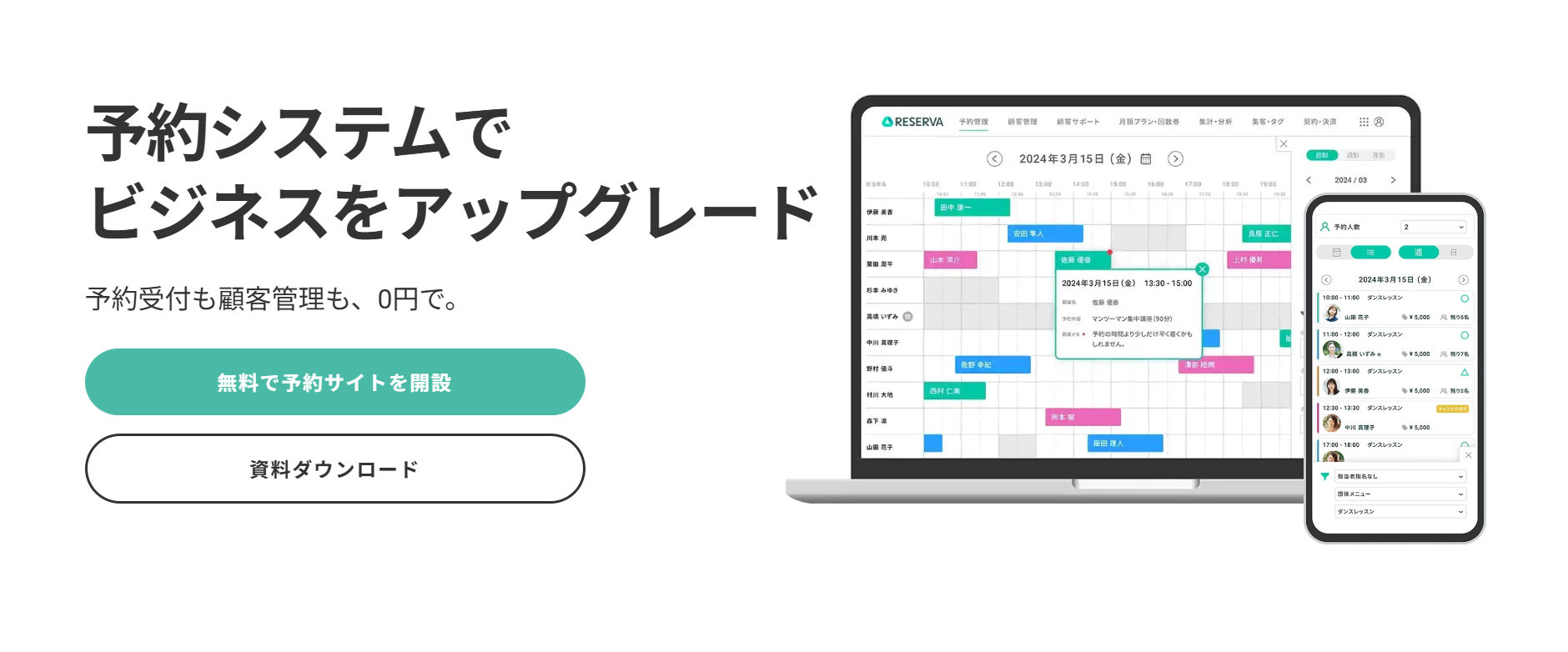
For managing class and lesson reservations, RESERVA one of Japan’s leading cloud-based reservation management systems used by more than 350,000 businesses, is an ideal choice. The platform supports a wide range of industries and business types and is currently used across more than 350 industries.
From account registration to completing a reservation website, setup can be finished in as little as three minutes. A permanently free plan is also available, making RESERVA a practical option for businesses that want to keep initial costs low or test the system before full implementation.

Conclusion

For foreigners operating classes and lessons in Japan, today’s environment makes it easier to attract students through social media and word of mouth. However, as the number of students increases, operational tasks such as handling reservations, coordinating schedules, and confirming payments also become more complex. In particular, when multiple communication channels are used simultaneously, the risk of missed reservations and delayed responses increases, which can negatively affect stable business operations.
To address these challenges, functions such as online reservations, automatic notifications, centralized customer information management, and advance payment systems can help reduce daily administrative workload while creating a more stable reservation process. At the same time, giving students the flexibility to register for or change reservations at their convenience can also improve the overall user experience.
Going forward, not only the quality of lessons themselves but also the entire experience — from making a reservation to attending the class — will become an important factor when students choose a class or course. Establishing an operational foundation at an early stage allows instructors to spend more time communicating with students and improving service quality. In particular, utilizing a reservation system that centrally manages everything from reservation handling to customer management is an effective way to build a flexible operational structure that can adapt to the growth of the class business.