

An increasing number of foreign residents living in Japan are using their experience and expertise to provide consulting services, such as career counseling, visa and daily-life consultation, study-abroad consultation, business startup consultation, language learning support, and mental health support. Consulting services can be operated online without a physical storefront, making them a relatively easy field to start as a sole proprietor or side business.
On the other hand, handling appointment reservations and scheduling manually can create a number of burdens, including missed messages, time-related mistakes, double reservations , and last-minute cancellation handling. This article explains what foreign residents should know when starting a consulting service in Japan, including how to accept reservations, common operational issues, useful reservation management functions, and how to use a reservation system effectively.
Why reservation management is important for running a consulting service

When foreign residents provide consulting services in Japan, establishing a reservation management system is essential. In particular, because Japanese business culture places great importance on punctuality, a smooth reservation process directly affects the credibility of the service. To prevent issues such as double reservations and maintain consistent service quality, it is important to first understand why reservation management matters.
Improving convenience for clients and reducing missed opportunities
In a consulting service, it is important that clients can book an appointment at the moment they decide they want to make a reservation. If reservations are accepted only by email or social media messages, the appointment cannot be confirmed until the consultant replies, and the client’s interest may decline during that time. By introducing online reservation, clients can check available time slots and choose a date and time that fits their schedule, which reduces hesitation before making a reservation. Especially in fields where clients want information quickly, such as career counseling or visa consultation, a shorter reservation process can help prevent missed opportunities.
Reducing the burden of scheduling and handling time differences
Consulting services for foreign residents may receive inquiries not only from clients in Japan but also from clients in their home countries or overseas. In such cases, it is necessary to exchange possible dates and times several times while taking time differences into account, which can make scheduling time-consuming. If available consultation slots are set in advance in a reservation system, clients can simply choose from the displayed time slots and complete the reservation . For the consultant, this reduces the need to send individual date and time suggestions by message, allowing more time to prepare consultation content and improve the service.
Preventing reservation errors and double reservations
Because each consultation usually has a fixed duration, it becomes difficult to respond properly if multiple reservations are made for the same time slot. When appointments are managed using a combination of notebooks, spreadsheets, and social media messages, it is easy to miss entering reservation information or make confirmation mistakes. By moving reservation management online, available time slots, reservation confirmations, and reservation status updates can be managed through a single system. Preventing double reservations is also important for maintaining trust with clients, and it is a point that individual consultants should prepare for at an early stage.
Challenges in accepting reservations when running a consulting service

This section looks at common challenges that arise when residents run consulting services in Japan. Consulting services are relatively easy to start as an individual or small team, but the operator needs to handle everything from appointment reservation and pre-consultation confirmation to payment and cancellation management. When the number of inquiries is small, manual handling may be manageable, but as the number of clients increases, managing schedules and communication becomes more complex. Understanding these challenges from the beginning and setting clear rules for accepting reservations can help improve the reliability and sustainability of the service.
The burden of managing reservations across multiple channels
When starting a consulting service, inquiries can easily become scattered across multiple channels, such as a website, email, LINE, Instagram, Facebook, and WhatsApp. Since each client has a different preferred communication method, expanding contact channels is effective for attracting clients. However, if each message is handled separately until the appointment is confirmed, it becomes difficult to keep track of which client wants to book which date and time. By consolidating the final reservation point into one place, you can continue receiving inquiries through multiple channels while managing reservation information in a centralized way.
Time-consuming handling of last-minute cancellations and schedule changes
When starting a consulting service, handling last-minute cancellations and schedule changes can be a major burden. If everything is managed manually, the operator has to confirm the change request, suggest available time slots again, and update the calendar, all through individual messages. Especially for online consultations, it may also be necessary to reissue the meeting URL and resend the guidance email, which often takes additional time.
The complexity of collecting consultation fees and handling advance payments
When offering a paid consulting service, it is necessary to clearly define how consultation fees will be collected. If payment is made on the day of the appointment or by bank transfer, checking incoming payments and dealing with unpaid fees can become ongoing issues for sole proprietors. In particular, if a no-show occurs, meaning the client does not appear on the day without contacting the provider in advance, the reserved time and expected revenue are lost. In addition, sending reminders for late payments and managing bank account transaction records can create both mental and administrative burdens, making it difficult to focus on the core consulting work.
Effective reservation management functions to consider
A reservation system is not only a tool for filling appointment slots. It is also a comprehensive mechanism that supports guidance, payment, reminders, and centralized customer information management. The main functions to consider when implementing one are as follows.

24-hour automated online reservation
With online reservation, clients can check available time slots 24 hours a day and choose the date and time they want. If the consultants sets available consultation days, time slots, consultation length, and reservation deadlines in advance, there is no need to coordinate each appointment individually. For one-time consulting services such as career counseling, study-abroad consultation, visa consultation, or daily-life consultation, dividing reservation menus by consultation type makes it easier to organize session length and fees. For clients, being able to check the time required and the cost in advance also helps reduce anxiety before making a reservation.
Online meeting URL issuance and reminder notifications
By linking a reservation system with Zoom or Google Meet, it is possible to issue online meeting URLs automatically. In addition, reminder notifications sent the day before or on the day of the consultation can help reduce forgotten appointments and no-shows.
Credit card advance payments and customer information management
By incorporating credit card payments into the reservation process, consultation fee collection can be automated. This helps reduce the risk of unpaid fees and also helps prevent no-shows. At the same time, if the reservation form is used to ask about the consultation topic or preferred language in advance, it becomes easier to prepare a preliminary client record and get ready for the consultation.
| Required function | Main role | Example use in a consulting service |
|---|---|---|
| Online reservation | Automatically accepts available time slots | Accepts 24-hour reservations for career counseling, visa consultation, and other services |
| Reminder notifications | Prevents forgotten appointments and no-shows | Automatically sends the meeting and appointment details the day before or on the day of the session |
| Advance payment | Helps address unpaid fees and no-shows | Collects fees by credit card at the time of reservation |
| Customer information management | Organizes client records and supports preparation | Checks preferred language, consultation topic, and past history |
For a reservation system, choose “RESERVA”
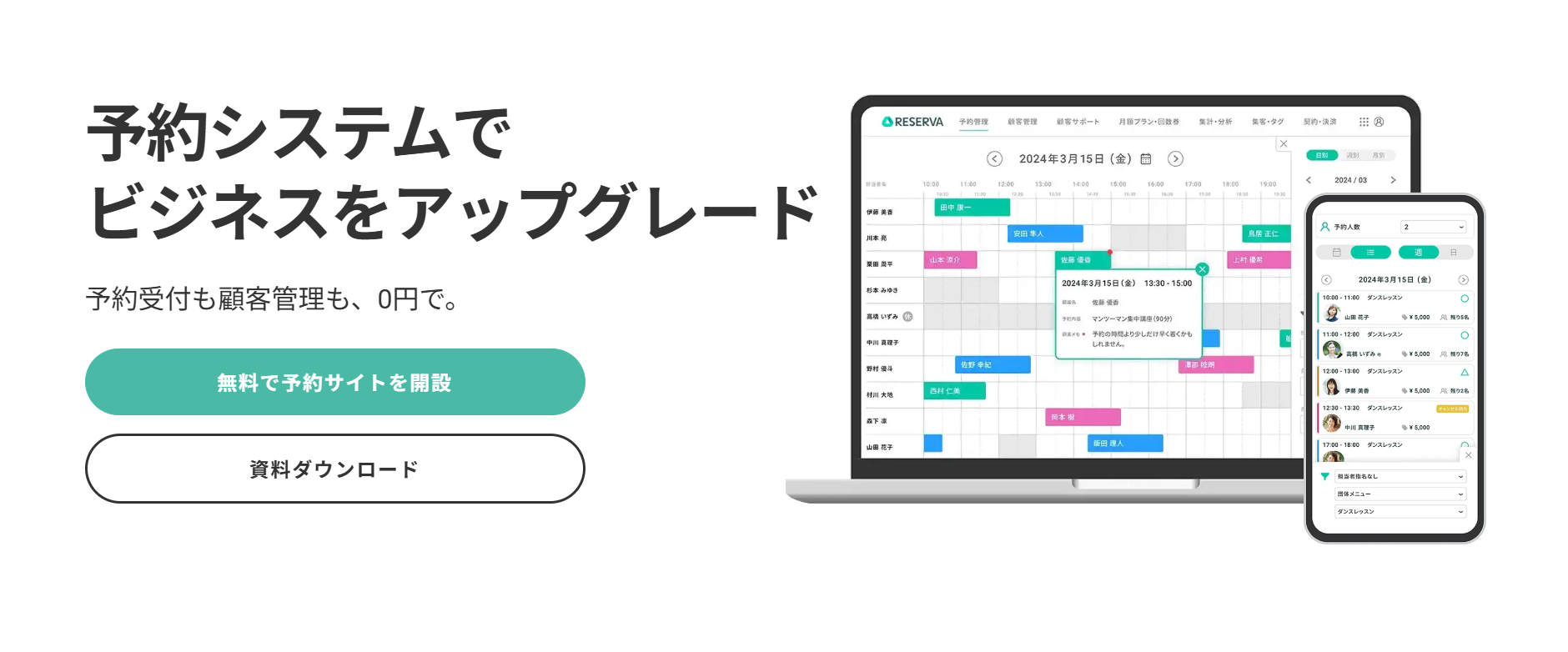
For accepting reservations in consulting services started by foreign residents in Japan, the cloud-based reservation management system RESERVA is an excellent option. It has been introduced by 350,000 businesses and is recognized as one of Japan’s leading reservation systems in terms of market share. RESERVA supports a wide range of industries and business types, being utilized across more than 350 service categories. The platform is highly efficient, taking as little as 3 minutes from account creation to completing the reservation system setup. Additionally, RESERVA offers a permanently free plan, making it ideal for businesses that want to keep implementation costs low or test usability before full-scale adoption.

Summary

For foreign residents to establish a stable consulting service in Japan, it is important not only to provide professional knowledge but also to build a reservation process that gives clients a sense of security. Before manual scheduling reaches its limits, consider introducing a reservation system equipped with functions such as online reservation, advance payment, and reminder notifications. Systematizing the process reduces administrative workload and helps you make better use of valuable time spent with each client.