
For foreign entrepreneurs opening a store or launching a service in Japan, an online booking system is more than a tool for accepting customer reservations. According to the Immigration Services Agency of Japan, the number of foreign residents in Japan reached 4,125,395 at the end of 2025, an increase of 9.5% from the previous year. The Japan National Tourism Organization also reported that Japan received 42,683,600 international visitors in 2025, creating greater business opportunities targeting Japanese customers, foreign residents, and international travelers. To serve a diverse customer base, businesses need a booking environment that allows users to check service details and availability without being restricted by language barriers or opening hours.
When reservations are accepted separately by telephone, email, or social media, business owners must spend time listening and replying in Japanese and manually transferring information to a booking ledger. This approach increases the risk of incorrect dates, missed messages, and incomplete records. The burden can be particularly significant for small businesses where the owner is responsible for customer service, payments, and marketing in addition to delivering the main service. An online booking system brings reservation acceptance, customer information, and confirmation messages together in one place. This article explains the common booking-related challenges foreign entrepreneurs face in Japan, why a booking system is necessary, and what to check before selecting one.
- 1. Common Booking Challenges for Foreign Entrepreneurs Starting a Business in Japan
- 1.1. Telephone Bookings in Japanese Can Lead to Misunderstandings and Recording Errors
- 1.2. Bookings Cannot Be Accepted Outside Business Hours
- 1.3. Booking Information Becomes Scattered Across Telephone Calls and Social Media
- 1.4. Prices and Service Conditions May Not Be Explained Clearly
- 1.5. Booking Tasks Become Concentrated on the Owner in a Small Business
- 1.6. Changes, Last-Minute Cancellations, and No-Shows Are Difficult to Manage
- 2. Why Foreign Entrepreneurs Starting a Business in Japan Need an Online Booking System
- 2.1. Customers Can Review Their Booking Details Online
- 2.2. Businesses Can Accept Reservations 24 Hours a Day and Increase Customer Opportunities
- 2.3. The Booking Process Can Be Made Accessible to Both Japanese and International Customers
- 2.4. Reservation and Customer Information Can Be Managed in One Place
- 2.5. Confirmation Emails and Appointment Reminders Can Be Sent Automatically
- 2.6. Cancellation Conditions Can Be Communicated Consistently
- 2.7. Advance Online Payment Can Improve Payment Operations
- 3. What Foreign Entrepreneurs Should Check When Choosing an Online Booking System
- 3.1. Can the System Support a Booking Method Suitable for the Business?
- 3.2. Can the Management Screen Be Operated Without Difficulty?
- 3.3. Can Customers Book Easily from a Smartphone?
- 3.4. Does the Pricing Structure Match the Start-Up Budget?
- 3.5. Are Japanese Instructions and Customer Support Available?
- 3.6. Can Customer Information Be Managed Securely?
- 4. Choose RESERVA for Your Online Booking System
- 5. Summary
Common Booking Challenges for Foreign Entrepreneurs Starting a Business in Japan

Foreign entrepreneurs operating a store or service in Japan must handle a wide range of booking-related tasks, including telephone inquiries, requests received outside business hours, and reservations arriving through multiple channels. Even if they can communicate in Japanese in everyday situations, accurately hearing and recording customer names, telephone numbers, appointment times, and service names while serving other customers can be difficult. When reservation methods are not standardized, information becomes scattered across paper records, email accounts, and social media platforms, increasing the risk of missed requests and double bookings. This section explains the booking challenges that foreign entrepreneurs commonly face after opening their businesses in Japan.
Telephone Bookings in Japanese Can Lead to Misunderstandings and Recording Errors
When accepting a booking by telephone, the business owner must confirm the customer’s name, contact details, preferred date and time, number of participants, and requested service entirely through conversation. A foreign entrepreneur who is not familiar with Japanese honorific language, fast speech, regional accents, or names with similar pronunciations may misunderstand numbers or proper nouns. If the call arrives while the owner is performing a treatment or serving another customer, it may be difficult to confirm the details carefully, leading to lost notes or forgotten entries in the booking ledger. By providing a booking form where customers enter the necessary information themselves, the business can reduce verbal communication and review the submitted details directly on the screen.
Bookings Cannot Be Accepted Outside Business Hours
When reservations are accepted only by telephone or in person, customers are generally limited to making bookings during the business’s opening hours. However, many customers search for salons, classes, consultation services, and activity facilities at night after work or school, while commuting, or on the business’s regular closing days. If they cannot find a way to book at that moment, they may choose another business that offers online reservations. Newly opened businesses often have limited brand awareness and few repeat customers, making it important to accept reservations as soon as potential customers become interested. A 24-hour booking system helps prevent these valuable opportunities from being lost.
Booking Information Becomes Scattered Across Telephone Calls and Social Media
To attract customers soon after opening, many businesses accept reservations through several channels, including telephone, email, Instagram, LINE, and in-person inquiries. Offering multiple contact methods can increase the number of customer touchpoints, but it also causes reservation information to be distributed across different screens and paper records. A workflow in which one customer receives a social media reply, another receives an email, and all details are later copied into a paper ledger can result in forgotten responses, transcription mistakes, and double bookings. Even when several booking channels are offered, the final reservation information should be collected in one management screen. Availability must also be shared across all channels to prevent scheduling conflicts.
Prices and Service Conditions May Not Be Explained Clearly
Before booking a business for the first time, customers usually want to check the price, service duration, location, payment methods, required items, and cancellation conditions. If this information is not clearly organized on the website or booking page, customers must ask each question individually by telephone or message. If a foreign business owner does not fully understand the purpose of a question, or if different staff members provide different explanations, disagreements about prices or service details may arise after the customer arrives. Displaying standardized terms on the booking page allows customers to confirm the necessary information before making a reservation. It also reduces the amount of time the business spends repeatedly explaining the same details.
Booking Tasks Become Concentrated on the Owner in a Small Business
Foreign entrepreneurs starting a business in Japan may initially operate alone, with family members, or with only a small number of employees. If the owner cannot answer a telephone call while providing a service, they must return the call later and organize reservations received by email and social media after business hours. When every booking change or cancellation must be manually added to a ledger, administrative work continues even after the business closes. This reduces the time available for rest, marketing, and business development. Automating booking acceptance and confirmation messages is not merely a way to save time but an important foundation for maintaining a sustainable business with limited staff.
Changes, Last-Minute Cancellations, and No-Shows Are Difficult to Manage
For appointment-based businesses, rescheduling, last-minute cancellations, and no-shows can prevent another customer from using the vacant time and may directly reduce revenue. If changes are accepted only by telephone or individual messages, customers may not be able to find the correct contact method, while the business may fail to notice the updated information. Disputes may also occur when cancellation deadlines and fees are not clearly stated in advance. Displaying the cancellation policy during the booking process helps ensure that customers understand the conditions before confirming their reservations. Confirmation emails and advance reminders can also reduce forgotten appointments and allow all customers to be handled under the same rules.
Why Foreign Entrepreneurs Starting a Business in Japan Need an Online Booking System

Foreign entrepreneurs need an online booking system not only to reduce the burden of communicating in Japanese but also to combine reservation acceptance, customer management, marketing, and communication in one place. When customers can check services and availability on the booking page, the business owner no longer needs to repeat the same explanation by telephone or message. Confirmation messages and instructions sent before the appointment can also be automated, allowing a small business to establish a consistent booking process. These functions help owners spend more time on the services that generate revenue. This section explains the specific benefits of introducing an online booking system in Japan.
Customers Can Review Their Booking Details Online
An online booking system can display service names, prices, service durations, availability, and terms of use in one place. Customers can compare the available options and select their preferred service and time without calling the business. This reduces the need for foreign entrepreneurs to repeatedly explain prices and service details in Japanese and helps prevent misunderstandings or missing information. Businesses can also configure questions that customers must answer when booking. Their purpose, preferences, and other requirements can therefore be confirmed before arrival, allowing the business to prepare appropriately and provide smoother service on the day.
Businesses Can Accept Reservations 24 Hours a Day and Increase Customer Opportunities
An online booking system allows a business to accept reservations 24 hours a day, regardless of its opening hours or regular closing days. Customers can check availability and book at a convenient time, including after work or school, while commuting, or during holidays. Newly opened businesses usually have limited recognition and few regular customers, so it is important to let interested customers complete their reservations immediately. Links to the booking page can be added to websites, map listings, and social media profiles. This creates a direct path from discovering the business to making a reservation and reduces the number of potential customers who make an inquiry but never complete a booking.
The Booking Process Can Be Made Accessible to Both Japanese and International Customers
The customers of a foreign entrepreneur in Japan are not necessarily limited to people from the same country or region. Reservations may come from Japanese customers, foreign residents, and international visitors with different languages and cultural backgrounds. Providing prices and booking instructions in Japanese and adding explanations in other languages where necessary can make the page easier for a wider range of customers to use. Sharing service information and conditions on the screen reduces dependence on verbal communication. This approach helps the business and its customers develop a common understanding and reduces the risk of problems during booking or on the day of the appointment.
Reservation and Customer Information Can Be Managed in One Place
An online booking system allows the business to review appointment dates, selected services, customer names, contact information, and service histories from one management screen. Compared with a process where information is scattered across paper records, email, social media, and spreadsheets, this approach reduces the time required to find and re-enter information. When a booking is changed or canceled, updating the management screen makes the latest information available to other staff members. A shared management method also becomes increasingly important as the number of employees grows. It prevents the business from becoming dependent on one person who is the only individual able to understand the full schedule.
Confirmation Emails and Appointment Reminders Can Be Sent Automatically
Some online booking systems automatically send a confirmation email when a reservation is completed and a reminder before the appointment date. The message can include the appointment time, business location, required items, and important instructions, allowing the customer to review the details whenever necessary. Business owners no longer need to prepare and send individual Japanese messages for every reservation, reducing the risk of communication being missed or written incorrectly. Reminders can also reduce forgotten appointments and mistakes about dates or times. This makes automated notifications an effective measure against empty appointment slots and revenue losses caused by no-shows.
Cancellation Conditions Can Be Communicated Consistently
Appointment-based businesses need to establish cancellation deadlines, cancellation fees, and procedures for late arrivals in advance. If these conditions are explained separately by telephone or social media, the information may vary depending on the staff member or customer. Displaying the conditions on the booking page and requiring customers to review them before completing a reservation creates a consistent process. The business can therefore accept every reservation under the same rules. Clearly explaining how to reschedule or cancel also makes the process easier for customers and reduces the time the business spends responding to individual requests.
Advance Online Payment Can Improve Payment Operations
Online booking systems that support digital payments allow customers to pay the service fee when making their reservations. Advance payment reduces cash handling and payment processing on the day of the appointment, creating a shorter and smoother process from arrival to departure. Confirming the amount in advance can also prevent misunderstandings between foreign business owners and their customers regarding the amount due. Businesses providing expensive services or services requiring preparation costs can combine advance payment with cancellation conditions. This approach may help reduce losses resulting from last-minute cancellations.
What Foreign Entrepreneurs Should Check When Choosing an Online Booking System
When choosing an online booking system, foreign entrepreneurs should not base their decision only on the number of functions or the system’s popularity. They need to determine whether the service is suitable for their industry, Japanese-language ability, customer base, and business size. It can be difficult to accurately predict reservation numbers and sales immediately after opening, so a system that supports small-scale use and allows functions to be added later is often suitable. The customer-facing booking page is as important as the business management screen. This section explains the key points that should be checked to ensure the system remains practical after implementation.
Can the System Support a Booking Method Suitable for the Business?
The appropriate booking process depends on the type of store or service. Salons and consultation services may need customers to select a staff member and time, while restaurants need to manage party sizes and seating. Classes and events require control over scheduled dates and attendance limits. Before choosing a system, the business should identify the order in which customers will select services, staff members, dates, times, and participant numbers. If the booking method does not match the business model, telephone calls and manual adjustments will remain necessary even after the system has been introduced.
Can the Management Screen Be Operated Without Difficulty?
To continue using an online booking system, foreign entrepreneurs must be able to understand the management screen and its operating procedures. They should check whether they can create booking slots, change opening hours, register temporary closures, and modify or cancel reservations themselves. Even when some Japanese expressions are difficult, a clear screen layout and illustrated help pages can make configuration easier with the assistance of translation tools. Businesses should use a free plan or trial environment when available. Registering an actual service and testing the entire process from customer booking to administrator management can reveal potential problems before full implementation.
Can Customers Book Easily from a Smartphone?
Many customers use smartphones rather than computers to search for businesses and complete their reservations. If the text is too small, the form contains too many fields, or the booking button is difficult to find, customers may leave the page before completing the process. Business owners should open the page as a customer and check whether they can move from service selection to booking completion without confusion. This review is also important when serving customers who are not confident in Japanese or international visitors. Images, prices, service durations, and selectable options should all be easy to understand visually.
Does the Pricing Structure Match the Start-Up Budget?
When comparing booking systems, businesses should review not only the monthly fee but also setup costs, additional charges based on booking volume, payment processing fees, and fees for optional functions. A low monthly fee may still exceed the planned budget if every necessary feature requires an additional payment. In contrast, an expensive plan may become a financial burden if the business cannot use most of its features immediately after opening. Starting with a free or lower-cost plan can help the business control its fixed expenses. It is also useful to choose a service that allows the plan to be upgraded as bookings and employee numbers increase.
Are Japanese Instructions and Customer Support Available?
Problems may occur while configuring or operating a booking system, including unavailable booking slots, missing notification emails, or payments that cannot be confirmed. Operation guides, frequently asked questions, and inquiry forms make it easier to identify the cause and resolve the problem. Even when support is not available in another language, clearly organized Japanese guidance with images can often be understood with automatic translation. Before implementation, the business should check the available contact methods, support hours, and quality of the help materials. This review helps determine whether the owner can respond effectively when a problem occurs.
Can Customer Information Be Managed Securely?
Online booking systems handle personal information, including customer names, telephone numbers, email addresses, and service histories. Managing this information only through a personal smartphone, private social media account, or paper notes increases the risk of data being exposed when a device is lost or an employee leaves the business. A business-focused booking system should be used so that access to the management screen and staff permissions can be controlled. Internal rules are also necessary in addition to the system’s functions. Passwords should not be reused, and the accounts of former employees should be disabled promptly to protect customer information.
Choose RESERVA for Your Online Booking System
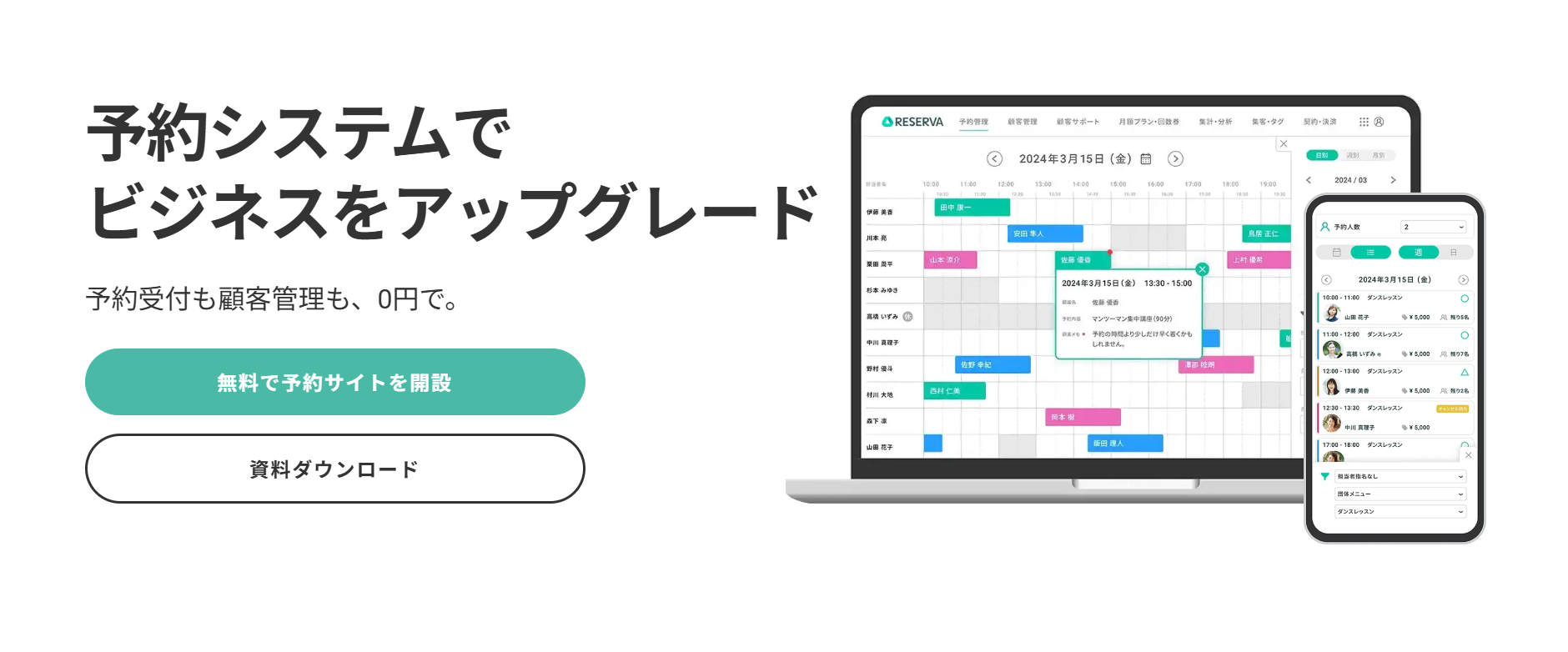
Foreign entrepreneurs accepting reservations when starting a business in Japan can benefit from RESERVA, a leading cloud-based booking management system used by 350,000 businesses. RESERVA supports a broad range of industries and business types and is used in more than 350 categories. A booking website can be created in as little as three minutes after creating an account. RESERVA also offers a permanently available free plan. It is therefore suitable for businesses that want to minimize implementation costs or confirm the system’s usability before upgrading to a paid plan.
A Booking Website Can Be Created Immediately After Starting the Business
RESERVA allows foreign entrepreneurs to create an online booking page even if they have not yet prepared a separate website for their store or service. The business registers its service name, price, duration, and available dates and then shares the generated booking page with customers. Publishing the page on social media, map listings, business cards, and flyers can direct potential customers to online booking. The booking process can be tested during the preparation stage before the business officially opens. This allows the owner to review the page layout and notification content and make any necessary changes before serving actual customers.
Booking Methods Can Be Configured for a Wide Range of Industries
Foreign entrepreneurs in Japan may operate businesses in fields such as beauty, food services, language education, tourism activities, consultation, repairs, photography, and health-related services. RESERVA allows the booking method to be configured according to the business model, making it easier for customers to select the required service and appointment time. Setting available hours and participant limits also reduces the need to confirm availability manually by telephone or message. The operating method can be reviewed as the business grows. RESERVA can continue supporting both booking acceptance and customer management as the business expands.
The Free Plan Allows Businesses to Test the Booking Process
Before opening, it can be difficult to predict how many reservations the business will receive and which functions will be necessary. RESERVA offers a permanently available free plan, allowing entrepreneurs to create a booking website without making a large initial investment. The owner can make a test booking to check the notification sent to the customer, the information displayed on the management screen, and the procedures for making changes or cancellations. A higher plan can be considered when booking numbers increase or additional functions become necessary. This approach allows the business to establish its booking management process gradually while keeping start-up expenses under control.

Summary
Foreign entrepreneurs starting a business in Japan need an online booking system to reduce the burden of accepting telephone reservations in Japanese and to give customers a way to check services and availability independently. Functions such as 24-hour booking, centralized reservation management, and automatic notifications help businesses accept requests outside opening hours while reducing misunderstandings and missed responses. Clearly displaying prices and cancellation conditions creates an understandable booking process for both Japanese and international customers. It also helps reduce differences in understanding when the service is provided. An online booking system is therefore not only a solution to language-related challenges but also an important foundation for operating a reliable and sustainable business with limited staff.
When selecting an online booking system, foreign entrepreneurs should confirm whether it supports the booking method required by their industry, whether the management and customer-facing screens are easy to use, and whether the pricing matches their start-up budget. Japanese-language operation guides, customer support, and functions for managing personal information should also be reviewed before implementation. Instead of immediately purchasing a plan with many functions, businesses can use a free plan to test the actual booking process and identify the features they truly need. Establishing the booking workflow during the preparation stage will help create an environment in which customers can make reservations with confidence. This preparation can support stable and sustainable business growth in Japan.